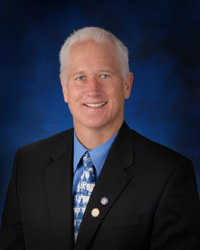




Dr. Ahlering on "The Doctors" Show
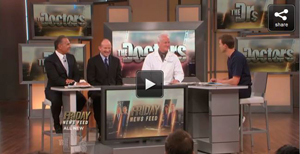
One million Americans are diagnosed with cancer every year, and that includes medical professionals. Orthopedic surgeon Dr. Bill Stetson opens up about being diagnosed with prostate cancer. View the video here »
Robot Assisted Radical Prostatectomy (RARP)
Minimally Invasive Removal of the Prostate for Cancer
One in six American men will be diagnosed with prostate cancer within their lifetime. Approximately 27,000 men die annually due to prostate cancer,
 making it the second most fatal cancer in men. Advances in the early detection and treatment of this disease are believed to have sharply increased survival. Ten-year disease specific survival rates of patients with a robotic prostatectomy are greater than 90%. When removal of the prostate is warranted, several important factors regarding the procedure are commonly taken into consideration by both patients and physicians:
* Prostate Cancer Surgery
* Safety of Robotic Prostatectomy
* Urinary Control or Continence
* Robotic Prostatectomy - Erectile Function
* Robotic Prostatectomy and Pain/Blood Loss
* Return to Work/Activities after robotic prostatectomy
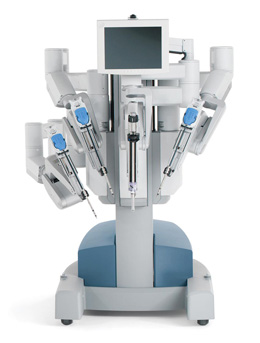
With such important issues at stake, it is important that patients receive the very best treatment possible. That is why the Department of Urology at the UC Irvine Medical Center was one of the first institutions to offer robotic prostatectomy using the da Vinci Robotic Slave Interface. This groundbreaking technology, listed as number one in Forbes Magazine's "Five Robots That Will Change Your Life," provides unprecedented 3-D vision and precise robotic instrument manipulation.
The initiation of this UC Irvine Department of Urology advanced technology was put in the skilled hands of its most capable prostate surgeon, Dr. Thomas Ahlering. Dr. Ahlering was already a very highly regarded surgeon in Urologic cancers, being listed as one of the original "America's Best Doctors" since his membership in 1994 and had already performed 500+ open radical prostatectomies, before transitioning to the da Vinci system.
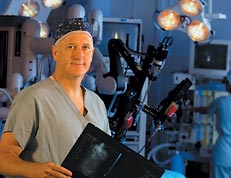 The UC Irvine Robotics program performed the first Robotic Prostatectomy in Southern California in June 2002, Dr. Ahlering has performed more than 1200 cases. In addition to being one of the oldest programs in the world, Dr. Ahlering has the second largest series of publications relating to robotic prostatectomy in the literature. Since the robotic program inception in 2002, Dr. Ahlering has written 50+ scientific publications and book chapters, specifically on robotic prostatectomy, of which 7 papers bring forth new advancements in techniques.
This work demonstrates that robotic prostatectomy produces superior outcomes for the patient in reduced blood loss, nearly zero blood transfusion, low complication rates, earlier return to work, and excellent oncological outcomes with low positive margin rates. The rate of return for pad-free urinary control in men is ~80% at 3 months and ~95% at one year after surgery. These findings validate the wisdom of the transition from open surgery to robotic prostatectomy.
Surgeons come from around the world to visit UC Irvine’s Douglas Hospital in Orange County, on a weekly basis, via our Mini-Residency and Intuitive da Vinci training programs, to learn from Dr. Ahlering's techniques. In January 2009, the American Urological Association selected UC Irvine to host a special three day symposium on Advanced Robotic and Laparoscopic Surgery. His recent honors include Physician of Excellence, Orange Coast Magazine (2005), and Intuitive Surgical's Pioneer of da Vinci Urology Surgery (2005).
The robotic prostatectomy is neither experimental nor a fad. In just seven years robotic prostatectomy has experienced geometric growth in the United States. In 2003 there were 2,648 procedures performed, in 2004 there were 8,642 and for 2005, 16,500 cases, or nearly 20%. In 2010 nearly 80% of all radical prostatectomies will be robotic prostatectomy.